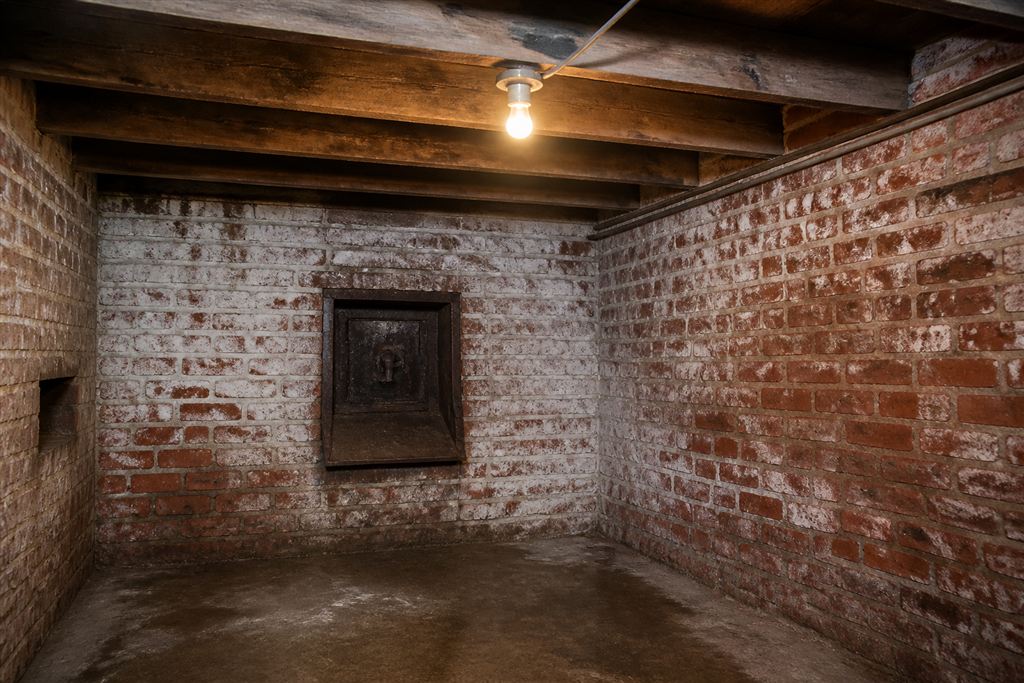
What “tanking a cellar” means on this stock
Homeowners use the phrase loosely. In LS17 it is not a grey slurry on lime brick, not a roll of tanking membrane hoped around a coal-chute frame, and not the same job as a mill terrace with one exterior wall.
It is a decision about clay water — and about Alwoodley Beck under King Lane toward Adel Woods — managed inside this room so the floor stays dry.
Three facts about this neighbourhood:
- Small coal rooms. Alwoodley Park halls took sacks, not a gym. A sump has to justify the floor it occupies.
- A shared wall. Primley Park and The Lane / The Drive semis mean a barrier stuck to the party wall is betting on the neighbour. A drained cavity does not need their brick to be dry.
- Internal access. Work comes down the stair or the chute. External excavation across a King Lane frontage with mature beeches is the wrong first move. Leeds Building Control is the authority, not Bradford.
How we actually tank a 1930s LS17 coal cellar
We do not arrive with a kit. After the discovery survey a typical Alwoodley Park / Primley Park utility is handled as a chute-and-clay room, not as a numbered national method statement.
The room is drawn first: moisture map, invert of the existing drain, party-wall thickness, whether the coal chute or the internal stair is the only way in, and whether a sump can sit without blocking the only standing space. Clay under King Lane and the Beck invert matter here. A Primley Park floor is not a mill-terrace invert.
Then we take off what has already failed — loose bitumen, a blown slurry, rotten timber linings — and we leave sound 1930s brick. We do not gut a semi because a supplier PDF said “hack off to substrate”.
The drained system is built inside: a short perimeter channel at the wall/floor joint on a one-room Primley Park cellar (longer on a Sandmoor light-well), falling to a packaged sump; dimpled cavity-drain membrane on walls and on the slab where it is wet, so water that arrives through clay or a failed land drain runs in the gap rather than across stored boxes; the pump discharging to the existing combined drain at the rear wherever the plot allows (where the water goes).
Last, Leeds City Council Building Control — Alwoodley is Leeds, not Bradford — where the works are structural waterproofing rather than a tin of paint.
Homeowners still search “tanking a cellar”. What they are buying on this stock is Type C cavity drain, specified for a chute-and-clay room, written up in the homeowner phrase.
Jobs we walk away from on this plot type
A dry meter cupboard under a 1950s house on The Fairway or the Buckstones is not this work. Late-1970s houses on Sunningdale, Turnberry, Wentworth or Gleneagles (the old Moor Allerton Golf Club streets) often have no cellar. A kitchen leak from above is a plumber.
The survey exists to say no. A full Type C on this stock commonly lands in the £10k–£30k band because you are lining a party-wall coal room, cutting a channel, and putting a pump on a Leeds drain — not because we padded a quote. A caller hoping a chute reveal will come right for a few hundred pounds is in the wrong place. What changes the price.
The other search: cellar tanking
The other search is cellar tanking. That URL is the comparison page: slurry and old bitumen already on Alwoodley walls, versus the Type C this page specifies. Do not paste this copy there. Cellar tanking vs Type C in Alwoodley houses
National product searches for tanking membrane are large . We name the product as a component of a chute-and-clay spec. We do not sell rolls.
A later playroom is not this ticket
If a playroom is even a maybe, say so while we are in the coal cellar so membrane laps and the sump are not ripped out when a floor finish goes down. Waterproofing still leads. Cellar conversion in Alwoodley (after waterproofing) Buttons still book the survey, never a conversion quote.
FAQs
Does tanking a cellar in an Alwoodley Park semi mean covering every wall in cement?
No. A cement coat on a Primley Park party-wall coal cellar blows at the chute reveal and wherever the shared wall moves. We specify a drained cavity unless the survey finds a dry cupboard that should be left alone.
Can you tank from the outside on Alwoodley Lane so we keep the cellar empty of membrane?
External tanking means excavating the plot. On Alwoodley Lane and The Avenue that fights mature trees, neighbour sight-lines, and clay that slumps. Internal Type C is the neighbour-sensitive method this stock was built for.
Will Leeds Building Control treat “tanking a cellar” as DIY?
Not if it changes structure or below-ground drainage. Alwoodley jobs sit with Leeds City Council Building Control. The discovery survey is the record for that notice.
How long does tanking last in an Alwoodley coal cellar?
A drained-cavity system is serviceable, not a one-shot coating: the membrane and channel runs last for decades, and the item that needs attention is the sump, which gets an annual check. The party-wall detail is where a cement coat would have blown first on this clay — the Type C detail there is designed to be opened and re-sealed, not to crack.